
Moving water as a scarce resource to grow more crops – is key to sustainable agriculture. The world’s need for greater food production amidst climate change demands a change in how we think about water use:
- Instead of flooding or spraying a field, think drip irrigation.
- Instead of fossil-fuel powering equipment, think solar.
- In addition to large-scale farming, think how smallholders can grow crops and increase income by solar powered water movement.
“Agrivoltaics” has sprung into parlance. Combining crop and energy production through vast solar panels installed above thousand-acre farmland. This is the focus of the U.S. Department of Energy’s Solar Energy Technologies Office.
Its Farmers Guide to Going Solar urges farmers to begin a two-harvest approach to the sun’s power – using solar panels to create energy and to grow crops.
But the Office also answers this FAQ to address the need for sustainable and efficient water movement for agriculture:
“Q. Can I use solar to power the irrigation on my farm?
A. Yes. Solar-powered irrigation is an excellent option, particularly if the irrigation is not near utility service. A solar irrigation system includes solar-powered pumps for the water-distribution system.”
Solar powered pumps are now on offer. Most come within kits, requiring assembly and installation.
The Soler SolutionsⓇ system moves beyond this to an out-of-the-box product that can be set up in minutes to move water from below ground or any water source to distances uphill and on level ground.
Coupling this with drip irrigation and using it for livestock watering, the system becomes an entirely off-grid means of moving water to increase farmer income through the sun’s power. It’s a form of freedom – from the grid, from public water supply, from fossil fuel use.
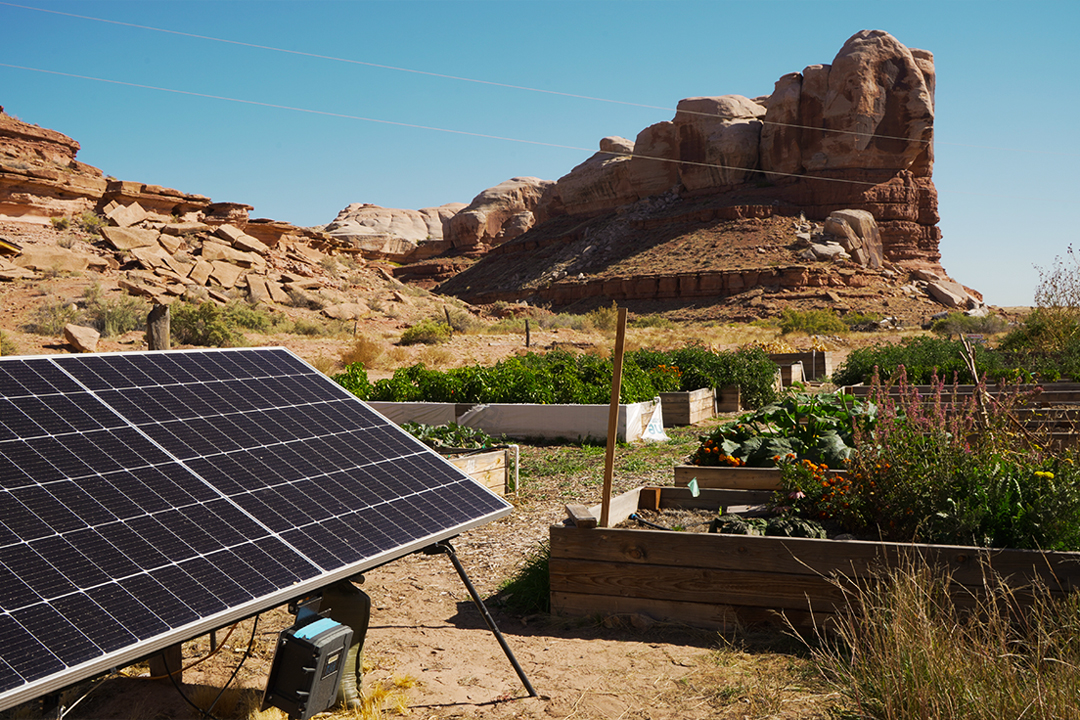
We donated a system to a Navajo community in Bluff, Utah. The product moves water from a water storage unit to 30 community garden beds. They produce fruits, vegetables, and flowers in a desert climate, in a location that is over a half hour drive from the nearest grocery store.
This is an effective example of how we don’t need to think thousand-acre farming to use solar energy in changing agriculture for a better world.
Credit – Joe Dehner Chairman Soler Solutions
